
Get in touch.
Questions about our services or looking to partner up?
Drop us a message we look forward to connecting.
Executive Summary:
Enterprises are at a critical inflection point in their digital transformation journeys. While automation, analytics, and generative AI have significantly improved efficiency and decision-making, most enterprise systems remain fundamentally reactive and human-dependent. The next evolution is Agentic AI—systems capable of autonomous goal-setting, reasoning, planning, and action within defined governance boundaries.
This white paper explores Agentic AI as a new operating model for intelligent enterprises. It outlines the conceptual foundations, architectural patterns, governance considerations, and practical enterprise use cases. It also provides a roadmap for organizations seeking to transition from traditional automation and copilots toward autonomous, agent-driven systems that operate at enterprise scale.
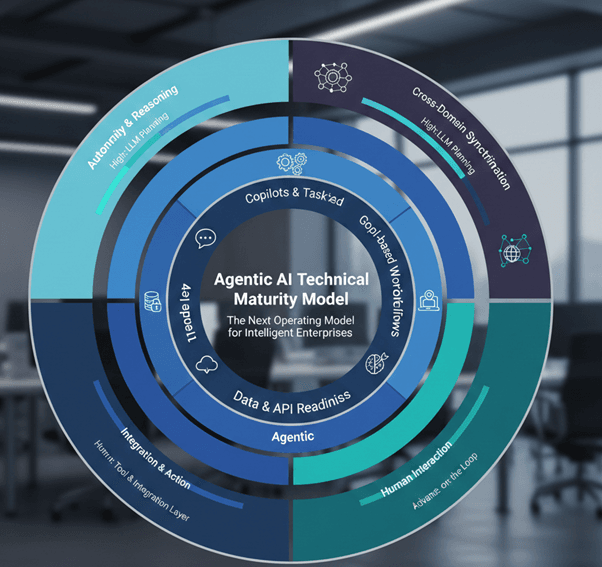
Introduction: The Limits of Today’s Enterprise AI
Over the last decade, enterprises have invested heavily in data platforms, robotic process automation (RPA), machine learning, and more recently, generative AI. These technologies have delivered measurable gains in productivity, insight generation, and customer experience. However, they share a common limitation: they depend on explicit human initiation and orchestration.
Current AI systems:
As enterprises grow more complex, the cost of manual coordination between systems, teams, and decisions continues to rise. Agentic AI addresses this gap by introducing autonomous intelligence that can reason, plan, and act across enterprise systems with minimal human intervention.
What Is Agentic AI?
Agentic AI refers to AI systems composed of intelligent agents that can:
Unlike chatbots or copilots, agentic systems are not limited to conversation or recommendation. They are designed to operate.
Key Characteristics of Agentic AI
Agentic AI as an Enterprise Operating Model
Agentic AI is not just a technology upgrade—it represents a new operating model for enterprises.
From Systems of Record to Systems of Action
Traditional enterprise IT focuses on systems of record and systems of insight. Agentic AI introduces systems of action, where decisions and execution are tightly coupled.
Organizational Impact
Human-in-the-Loop, Not Human-in-the-Path
Agentic AI enables humans to:
Rather than executing every step, humans oversee and guide intelligent agents.
Reference Architecture for Agentic AI
A scalable enterprise-grade Agentic AI architecture typically includes the following layers:
Agent Layer
Reasoning and Planning Layer
Tool and Integration Layer
Data and Knowledge Layer
Governance and Control Layer
Enterprise Use Cases
IT and Operations
Human Resources
Finance
Customer Experience
Governance, Risk, and Trust
Agentic AI introduces new risks alongside new capabilities.
Key Governance Principles
Enterprises must treat Agentic AI governance as a first-class capability, not an afterthought.
Roadmap to Adoption
Phase 1: Foundation
Phase 2: Assisted Intelligence
Phase 3: Agentic Workflows
Phase 4: Autonomous Enterprise
Conclusion
Agentic AI represents the next major shift in enterprise computing—moving from automation and assistance to autonomy and intelligence. Organizations that embrace this model early will gain decisive advantages in agility, efficiency, and innovation.
By thoughtfully combining advanced AI capabilities with robust governance and enterprise architecture, businesses can unlock a future where systems do not just support work they perform it.
Questions about our services or looking to partner up?
Drop us a message we look forward to connecting.