
Privacy-Preserving Agentic AI: Secure Architectural Patterns for Enterprise Data

Executive Summary:

Agentic AI represents the next evolution of artificial intelligence systems—autonomous, goal-driven agents capable of planning, reasoning, taking actions across systems, and continuously learning from outcomes. Unlike traditional AI models that respond to prompts or predefined workflows, agentic AI systems orchestrate tools, APIs, data sources, and other agents to achieve complex business objectives with minimal human intervention.
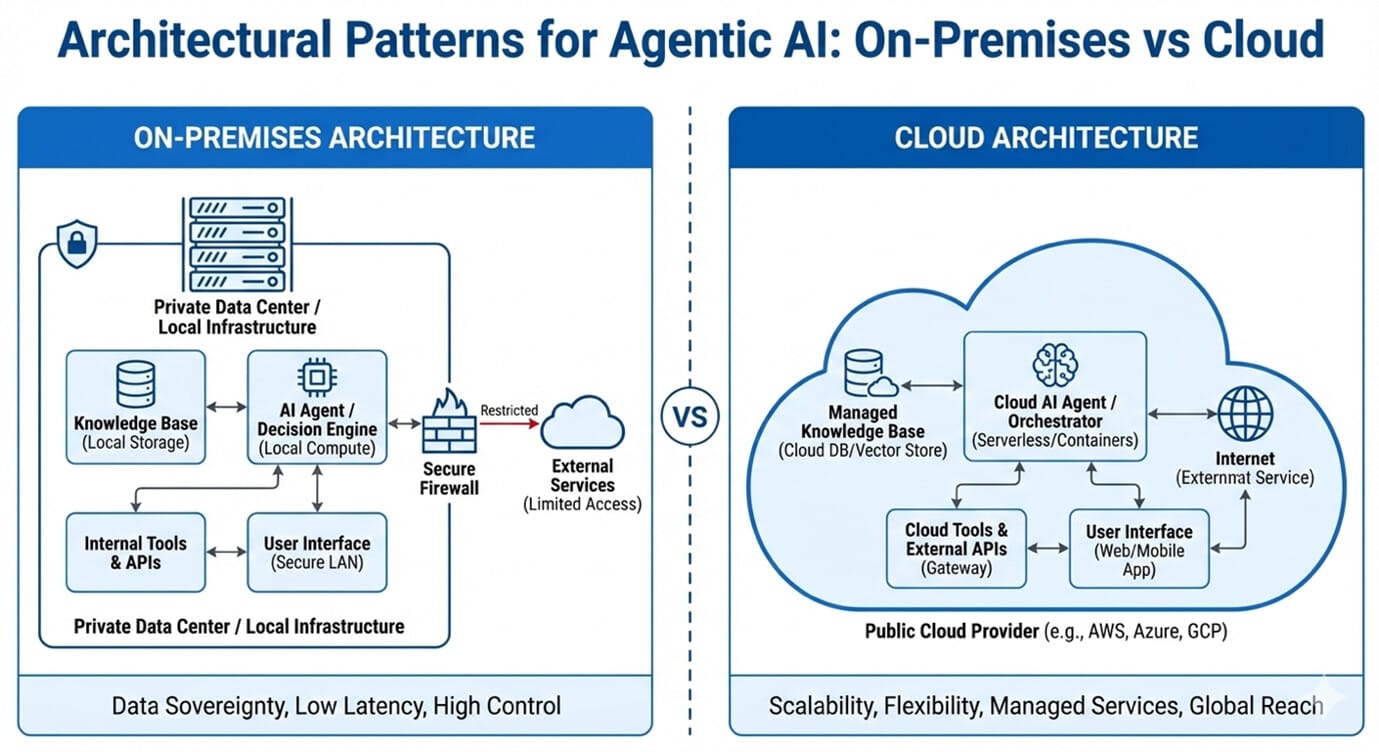
As enterprises evaluate agentic AI adoption, a critical architectural decision arises: Should agentic AI be deployed on-premises or in the cloud? This white paper provides a structured, vendor-neutral analysis of both deployment models, examining architectural implications, security and compliance considerations, scalability, cost, governance, and real-world use cases. The goal is to help technology leaders make informed decisions aligned with business strategy, regulatory constraints, and operational maturity.
Understanding Agentic AI

What Is Agentic AI?

Agentic AI refers to AI systems designed around autonomous agents that can:

  • Interpret high-level goals
  • Break goals into tasks and sub-tasks
  • Select tools or systems to interact with
  • Execute actions across digital environments
  • Observe results and adapt behavior

These agents often combine:

  • Large Language Models (LLMs)
  • Planning and reasoning engines
  • Memory (short-term and long-term)
  • Tool and API integrations
  • Feedback and learning loops

How Agentic AI Differs from Traditional AI

Traditional AIAgentic AI
ReactiveProactive and goal-driven
Single-step inferenceMulti-step reasoning and execution
Human-in-the-loop for most actionsHuman-on-the-loop governance
Isolated use casesEnd-to-end process orchestration

Common Enterprise Use Cases

  • IT operations automation (AIOps)
  • Autonomous business process execution
  • Intelligent customer support agents
  • Cybersecurity monitoring and response
  • Enterprise knowledge assistants
  • Supply chain and logistics optimization

Deployment Models Overview

On-Premises Deployment Model

On-premises agentic AI is hosted entirely within an organization’s data centers or private infrastructure. This includes compute, storage, networking, AI models, orchestration layers, and integrations.

Typical Characteristics:

  • Full control over infrastructure and data
  • Internal model hosting and fine-tuning
  • Integration with legacy and air-gapped systems
  • Higher upfront investment

Cloud Deployment Model

Cloud-based agentic AI is deployed using public or private cloud platforms, leveraging managed AI services, scalable infrastructure, and cloud-native integrations.

Typical Characteristics:

  • Elastic compute and storage
  • Access to managed LLMs and AI services
  • Faster innovation and deployment cycles
  • Usage-based pricing models

Hybrid and Multi-Cloud Patterns

Many enterprises adopt hybrid approaches:

  • Sensitive reasoning and data processing on-premises
  • Planning, orchestration, or non-sensitive inference in the cloud
  • Multi-cloud strategies to reduce vendor lock-in and improve resilience

Security, Privacy, and Compliance

On-Premises: Security Advantages

  • Data residency and sovereignty control
  • Easier compliance with strict regulations (e.g., defense, critical infrastructure)
  • Custom security architectures and access controls
  • Reduced exposure to external attack surfaces

On-Premises: Security Challenges

  • Responsibility for patching, monitoring, and incident response
  • Higher risk of misconfiguration without mature security operations
  • Limited access to advanced threat detection tools

Cloud: Security Advantages

  • Built-in security tooling and monitoring
  • Continuous patching and infrastructure hardening
  • Advanced identity, encryption, and zero-trust capabilities
  • Certifications for global compliance standards

Cloud: Security Challenges

  • Shared responsibility model complexity
  • Data sovereignty concerns across regions
  • Regulatory restrictions on external data processing

Compliance Considerations

Key compliance questions to address:

  • Where is data processed and stored?
  • Are model prompts and outputs logged?
  • How is agent decision-making audited?
  • Can actions be traced and explained?

Performance, Scalability, and Cost

Performance

On-Premises:

  • Predictable latency for internal systems
  • Optimized for local, high-throughput workloads
  • Limited by physical hardware capacity

Cloud:

  • Global low-latency access
  • GPU/TPU acceleration on demand
  • Potential network latency for on-prem integrations

Scalability

AspectOn-PremisesCloud
Compute scalingHardware-boundElastic and near-instant
Agent concurrencyLimitedMassive
ExperimentationSlowRapid

Cost Model Comparison

On-Premises:

  • Capital expenditure (hardware, licenses)
  • Long-term depreciation
  • Dedicated operations teams

Cloud:

  • Operational expenditure (pay-as-you-use)
  • Lower entry cost
  • Risk of cost sprawl without governance

Cost Optimization Strategies

  • Agent execution limits and quotas
  • Intelligent task batching
  • Hybrid inference strategies
  • Continuous cost monitoring

Governance, Observability, and Control

Governance Requirements for Agentic AI

Agentic AI introduces unique governance challenges:

  • Autonomous decision-making
  • Cross-system actions
  • Self-adaptive behavior

On-Premises Governance Strengths

  • Deep customization of policies
  • Direct integration with internal IAM and logging systems
  • Easier enforcement of strict approval workflows

Cloud Governance Strengths

  • Centralized dashboards and observability
  • Built-in audit trails and telemetry
  • Policy-as-code and automated compliance checks

Key Governance Capabilities

  • Human-in-the-loop approvals
  • Explainability and reasoning logs
  • Action simulation and sandboxing
  • Kill-switches and escalation paths

Observability Metrics

  • Agent task success rate
  • Action confidence scores
  • System impact and rollback frequency
  • Drift detection and behavior anomalies

Decision Framework and Recommendations

When to Choose On-Premises

  • Highly regulated industries
  • Strict data sovereignty requirements
  • Heavy integration with legacy systems
  • Long-term, stable workloads

When to Choose Cloud

  • Rapid innovation and experimentation
  • Variable or unpredictable workloads
  • Global-scale agent deployment
  • Limited internal AI infrastructure expertise

Hybrid as the Strategic Middle Ground

Hybrid deployments often provide the best balance:

  • Sensitive data and reasoning on-premises
  • Planning, orchestration, and non-sensitive inference in the cloud
  • Centralized governance with distributed execution

Future Outlook

Agentic AI will increasingly:

  • Operate across organizational boundaries
  • Collaborate with other agents and systems
  • Require real-time governance and ethical controls

Enterprises that invest early in a flexible deployment strategy—balancing control, scalability, and governance—will be best positioned to harness the full potential of agentic AI.

Conclusion

Choosing between on-premises and cloud deployment for agentic AI is not a binary decision. It is a strategic architectural choice shaped by regulatory context, risk appetite, operational maturity, and long-term AI vision. By understanding the trade-offs and adopting a principled decision framework, organizations can deploy agentic AI responsibly, securely, and at scale.

Make Your Enterprise Move Faster and Safer