
Get in touch.
Questions about our services or looking to partner up?
Drop us a message we look forward to connecting.
For the past decade, digital transformation was synonymous with Automation—the process of mapping human-defined workflows into code. While efficient, these systems were “brittle”; they could not handle nuance, adapt to errors, or operate outside a rigid script.
In 2024, the world met Generative AI, which added a layer of creative synthesis but remained tethered to human prompting. As we move through 2026, the industry has shifted to Agentic AI. This evolution represents the transition from software as a tool to software as an entity. Agentic systems do not wait for the next command; they understand a high-level goal, evaluate the environment, plan a sequence of actions, and execute them across multiple software ecosystems.
This paper outlines why this shift is not just a technical upgrade, but a fundamental change in the socio-economic fabric of the modern enterprise.
To function autonomously, an AI agent requires more than just a large language model (LLM) at its core. It requires an Agentic Stack.
Modern agents utilize Chain-of-Thought (CoT) and Tree-of-Thought reasoning. Instead of generating a single response, the agent creates multiple internal “drafts” of a plan, simulates the likely outcomes, and selects the most efficient path.
Simple Retrieval-Augmented Generation (RAG) is now replaced by Iterative Memory. Agents maintain:
An agent without tools is a brain in a jar. In 2026, agents are equipped with API “hands” that allow them to:
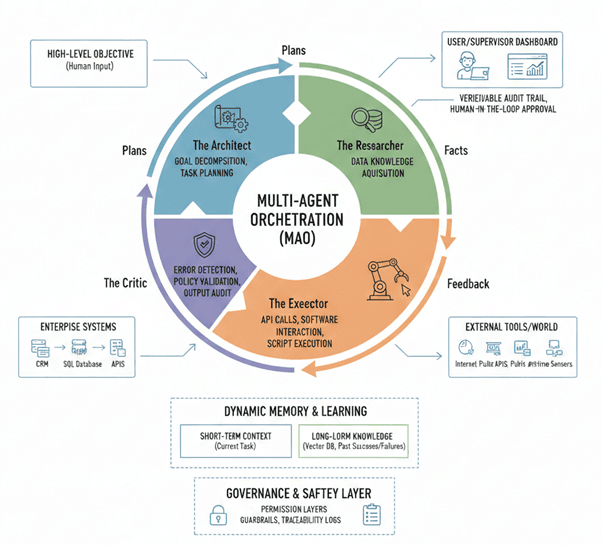
The most significant breakthrough in the past 12 months has been the move from single agents to Multi-Agent Orchestration.
In a complex enterprise environment, a single “God-Agent” is inefficient. Instead, organizations are deploying “Swarms”—specialized agents that collaborate.
| Agent Role | Responsibility |
| The Architect | Breaks down high-level goals into sub-tasks. |
| The Researcher | Scours internal and external data for facts. |
| The Executor | Interacts with software (ERP, CRM, Slack) to perform tasks. |
| The Critic | Reviews the output for errors, hallucinations, or policy violations. |
This “separation of powers” creates a self-correcting ecosystem. If the Researcher provides flawed data, the Critic rejects the plan before the Executor can act.
The transition to autonomy introduces the Control Gap. How do we trust a system that makes its own decisions?
The Human-in-the-Loop (HITL) Evolution
We are moving away from Human-in-the-loop (where the human does most of the work) to Human-on-the-loop (where the human supervises the agent’s work).
The shift to Agentic AI is fundamentally redefining the “Entry Level” job. Tasks that previously took a junior analyst 40 hours—data collection, basic synthesis, and report formatting—are now handled by agents in seconds.
The result: The role of the human employee is shifting from Execution to Curation and Strategy.
This creates a “skills chasm.” Organizations must urgently upskill their workforce to become “Agent Managers” rather than “Task Performers.”
For leaders looking to move beyond pilot programs, the path to autonomous maturity follows four stages:
The evolution from automation to agency is the most significant leap in computing since the invention of the internet. It marks the end of the “Command-and-Control” era of software and the beginning of “Objective-Based” collaboration.
Organizations that view AI merely as a way to generate text will be outpaced by those that view AI as a workforce of autonomous agents. The competitive advantage of 2026 belongs to the Agile Architect—the leader who can best orchestrate the synergy between human judgment and machine agency.
Questions about our services or looking to partner up?
Drop us a message we look forward to connecting.