Get in touch.
Questions about our services or looking to partner up?
Drop us a message we look forward to connecting.
The transition from Deterministic Automation (if-this-then-that) to Agentic Orchestration (goal-oriented reasoning) represents the most significant shift in enterprise architecture since the move to the Cloud. While traditional integration methods—namely RPA and custom API middleware—were designed for rigid, predictable processes, they are insufficient for the dynamic, non-linear nature of AI Agents.
This whitepaper explores the technical foundations of Agentic Workflows and proposes the Model Context Protocol (MCP) as the vital standard for Standardized Connectivity. By decoupling the “intelligence” of the model from the “plumbing” of the data source, organizations can build scalable, resilient, and truly autonomous ecosystems.
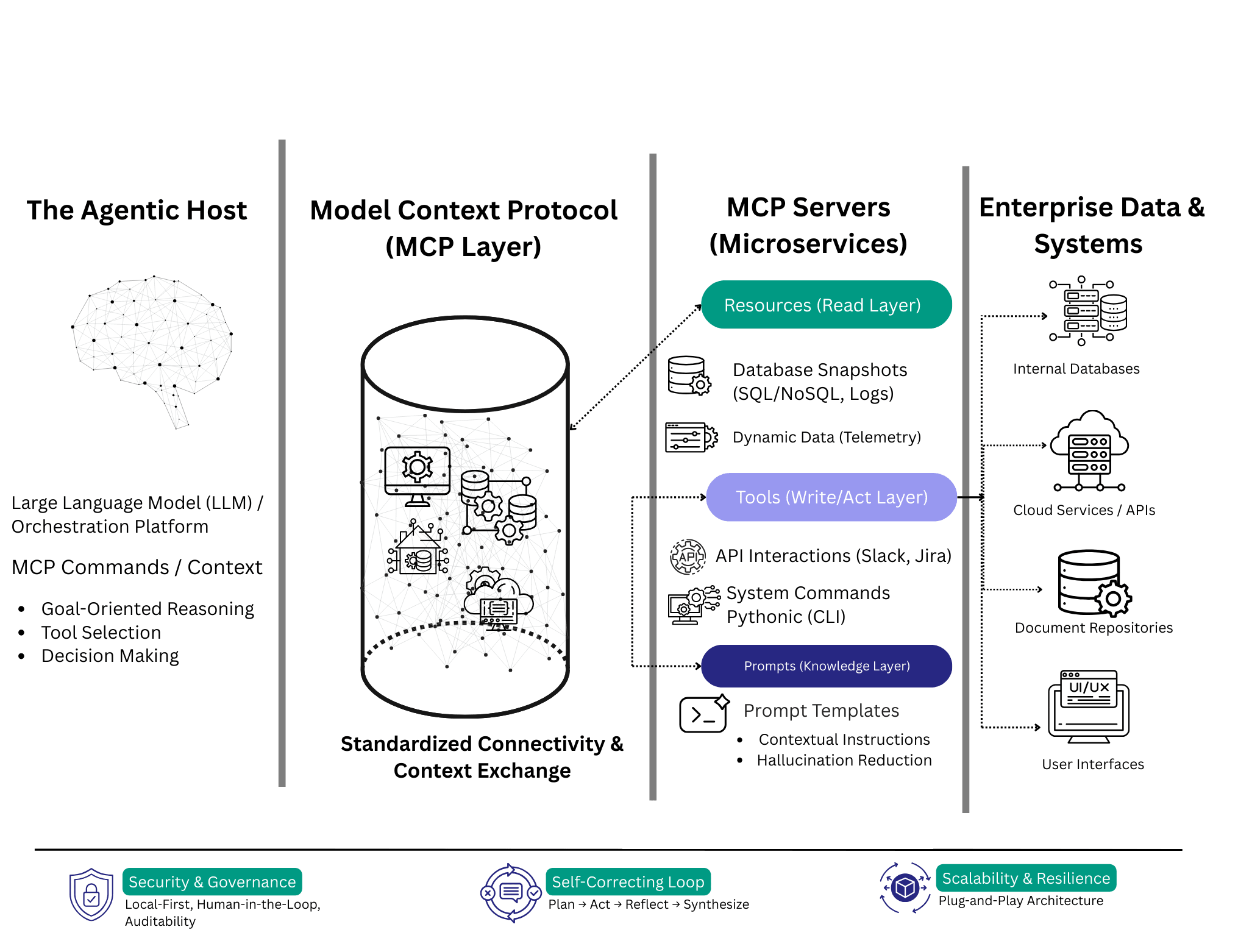
To build an “Agentic Enterprise,” we must differentiate between simple automation and true agency.
The Connectivity Bottleneck
The primary friction point for agents today is Contextual Retrieval. Agents spend 80% of their compute cycle trying to “understand” the data format or navigating the authentication hurdles of siloed systems. Without Standardized Connectivity, agents are “blind” to the enterprise data they are meant to orchestrate.
An agentic workflow is a self-correcting loop that operates through four distinct stages:
The agent receives a high-level prompt (e.g., “Perform a vendor risk assessment for our new logistics partner”). It decomposes this into sub-tasks:
In a standardized environment, the agent doesn’t need a hard-coded path to these systems. It queries its Connectivity Layer to find available tools. It then executes calls—not as a script, but as a series of informed decisions.
If a tool returns an error (e.g., “Vendor not found”), an agentic workflow doesn’t crash. It reflects: “Perhaps the vendor is listed under a parent company name.” It then adjusts its query and tries again.
The final output is not just raw data, but a synthesized report, often including a recommended action, created by pulling context from multiple disparate “Standardized” sources.
Until recently, connecting a model to a tool required writing custom “wrappers” for every single API. The Model Context Protocol (MCP) changes this by providing a universal interface between the AI and the data.
Resources are data sources that the model can pull into its context window. This includes:
Tools are executable functions that allow an agent to change the state of the world.
MCP allows servers to provide “Prompt Templates.” These are pre-defined instructions that tell the model how to best interact with that specific server’s data, reducing hallucinations and improving tool-use accuracy.
| Feature | RPA-Led Integration | Custom API/Middleware | MCP-Based Agentic Workflows |
| Interface | UI/Screen (Brittle) | API/Endpoint (Stable) | Semantic/Protocol (Intelligent) |
| Logic Source | Recorded Steps | Hard-coded Scripts | Model Reasoning (Dynamic) |
| Context Awareness | Zero | Low (Requires manual mapping) | High (Native context sharing) |
| Scalability | Linear (1 Bot = 1 Task) | Moderate (Requires IT dev) | Exponential (Plug-and-play) |
| Security | User-level (High risk) | Scoped API Keys | Fine-grained Protocol Permissions |
Standardized connectivity via MCP introduces a superior security model: The Sandbox Approach.
Step 1: The Resource Audit
Identify where your “high-value context” lives. Is it in Confluence, a PostgreSQL database, or local logs? Build or deploy MCP servers to expose these as resources.
Step 2: Tool Abstraction
Instead of building a “Customer Support Bot,” build a “Customer Data MCP Server” that provides tools like get_customer_history() and update_ticket_status(). Any agent you build in the future can now use these tools.
Step 3: Orchestration Deployment
Deploy an Agentic Host (such as a custom internal platform or an IDE-integrated agent) that can connect to multiple MCP servers simultaneously, allowing for cross-departmental reasoning.
The goal of the modern enterprise is to move from digitization to intelligence. Agentic Workflows provide the brain, but Standardized Connectivity (MCP) provides the nervous system. Organizations that adopt this protocol-based approach will be able to deploy autonomous agents that are safer, faster to implement, and infinitely more capable than those built on the fragile, fragmented integration methods of the past.
Questions about our services or looking to partner up?
Drop us a message we look forward to connecting.